
HPWBM: Bridging the Gap Between Conventional WBM and Oil-Based Systems
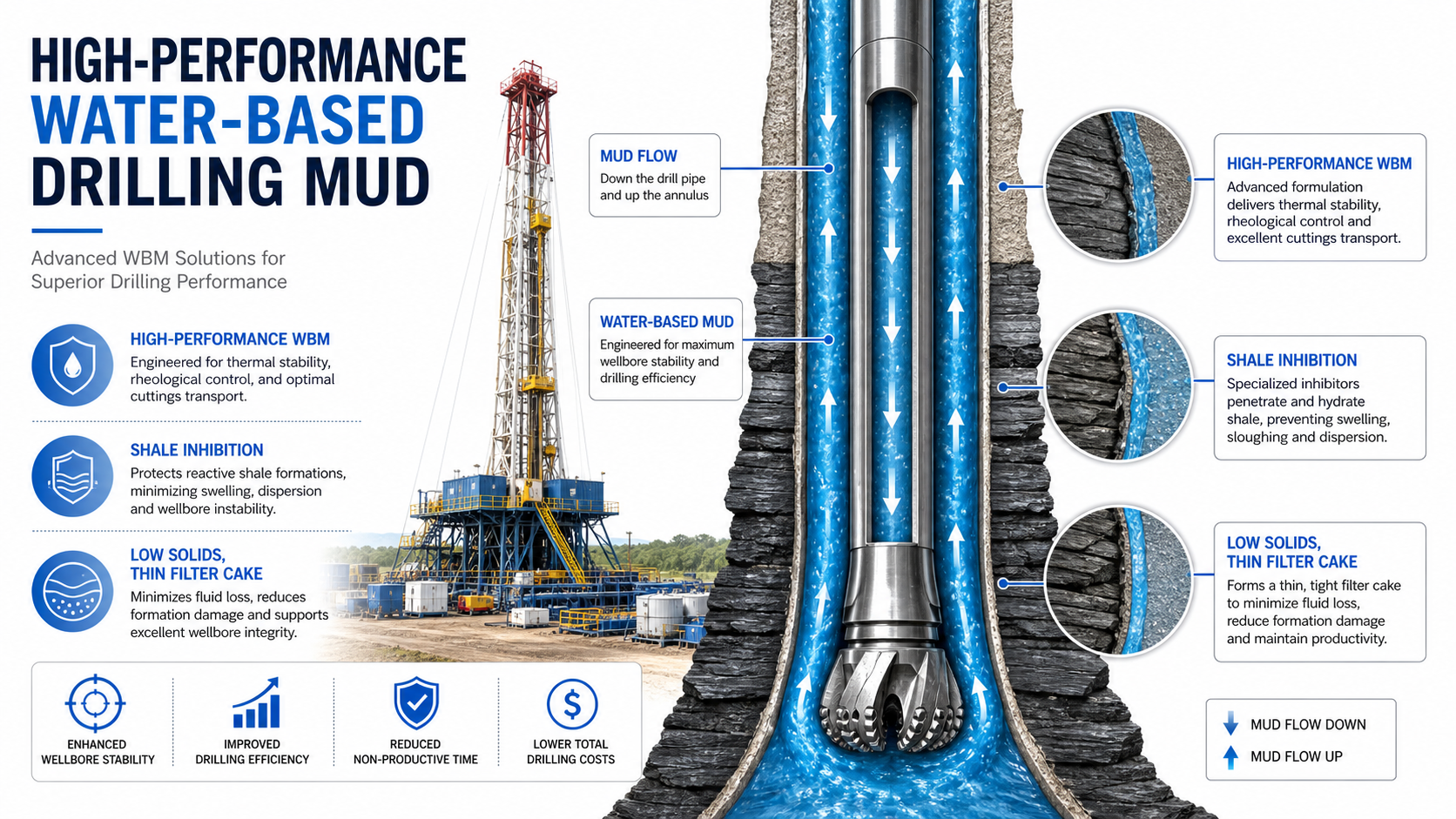
Water-based mud (WBM) systems have evolved significantly over the past two decades, moving far beyond traditional bentonite and lignosulfonate formulations. Today, High-Performance Water-Based Muds (HPWBM) are engineered to compete directly with oil-based (OBM) and synthetic-based (SBM) muds in technically demanding environments. They offer a more environmentally acceptable and often cost-effective alternative without compromising wellbore stability or drilling efficiency.
What Defines a High-Performance WBM?
HPWBMs are characterized by advanced polymer chemistry, tailored inhibition packages, and enhanced lubricity systems. These fluids are specifically designed to deliver:
Strong shale inhibition and encapsulation.
Reduced fluid loss and improved filter cake quality.
Enhanced lubricity for extended-reach and high-angle wells.
Thermal stability for moderately high-temperature applications.
Seamless compatibility with modern solids control systems.
Chemical Composition: Typical systems incorporate partially hydrolyzed polyacrylamide (PHPA), glycols, silicates, or amine-based inhibitors. These are often combined with nanoparticles or specialty additives to enhance wellbore stability and reduce reactive clay swelling.
Key Applications
HPWBM systems are increasingly deployed in environments where conventional WBMs would fail, but operators need to avoid the high costs, complex logistics, or environmental constraints of oil-based muds. Common applications include:
Extended-reach and horizontal wells: Where lubricity and torque reduction are critical.
Reactive shale formations: Particularly prevalent in the North Sea and Southeast Asian basins.
Environmentally sensitive areas: Where strict discharge regulations restrict the use of oil-based fluids.
Top-hole and intermediate sections: Where cost control is a priority but performance cannot be compromised.
Offshore operations: Where waste handling capacity is severely limited.
In many cases, HPWBM systems are successfully replacing OBM in sections historically considered entirely unsuitable for water-based fluids.
Technical Challenges
Despite their advantages, HPWBM systems have a distinct performance envelope that requires careful engineering and operational discipline. Key challenges include:
Maintaining inhibition in highly reactive formations over extended exposure times.
Managing rheology under fluctuating temperature and contamination conditions.
Achieving consistent lubricity comparable to oil-based systems.
Chemical degradation at elevated temperatures (typically above 120–150°C, depending on system design).
The Solids Control Factor: Solids control is critical to HPWBM performance. Unlike OBM, where oil-wetting mitigates some effects of fine solids, WBMs are highly sensitive to low-gravity solids buildup. This makes the optimization of shaker efficiency, desanders, desilters, and centrifuges absolutely essential.
Commercial Considerations
From a commercial standpoint, HPWBM systems offer a compelling value proposition, but the economics require a holistic view. The true commercial success of HPWBM lies in total well cost optimization rather than base fluid cost alone. When engineered correctly, these systems reduce drilling time, minimize waste, and deliver OBM-level performance at a lower total cost.
Advantages
Lower base fluid cost compared to OBM or SBM
Reduced environmental compliance and waste disposal costs
Simplified logistics for remote or offshore operations
Improved ESG alignment under regulatory pressure
Disadvantages & Trade-offs
Higher chemical complexity and specialty additive costs
Increased reliance on skilled mud engineers and real-time monitoring
Potential non-productive time (NPT) if fluid performance is mismanaged
Higher dilution and maintenance costs in solids-heavy environments
The Future of HPWBM
Ongoing developments in polymer science, nanotechnology, and fluid monitoring continue to push the boundaries of water-based systems. Emerging trends include:
Nanoparticle-enhanced inhibition and sealing.
Smart fluids equipped for real-time property monitoring.
Next-generation additives that are highly biodegradable and low in toxicity.
Integration with digital drilling optimization platforms.
As regulatory pressures increase and operators seek more sustainable drilling solutions, high-performance WBMs will play an increasingly central role in global operations. Ultimately, the question is no longer whether water-based mud can replace oil-based systems, but where and how far its performance envelope can be extended.